Drill.Marketing Market Intelligence Briefing

Louder Silence:
Why most builders are shouting into a void designed to ignore them.

Context & Disclosure

If you came here from a founder conversation or ad, here’s what this is:

This isn’t a sales page.
It’s a short research briefing on what seems to be breaking feedback loops for builders right now.

If you’ve felt like you’re shipping more but hearing less back from the market, this will likely feel familiar.

Read it like a field report, not a pitch.

Charles Heflin, Founder @Drill.Marketing

A structural analysis of why builders across every category are producing more content, running more tests, and spending more on distribution. Signal return is lower now than at any point in the last five years.

The Threshold Event Nobody Saw Coming

The environment changed before the analysis did. That gap is where most of the damage happened.

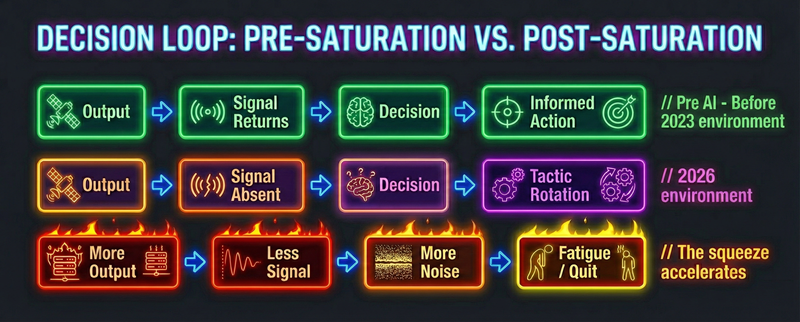
Distribution systems operate on feedback. A builder produces output, the market returns a signal (engagement, inquiry, revenue), and that signal informs the next decision. This loop is the fundamental mechanism behind any repeatable go-to-market operation.

In 2026, that mechanism degraded at scale. Not for one builder. Not in one channel. Across the category.

The precipitating condition was the commoditization of content production. Generative tools made it possible for any operator to produce professional-quality written content at near-zero marginal cost. The result was a rapid, structural increase in supply across every distribution surface simultaneously.

Signal Saturation Indicators: Q1 2026

The volume of AI-assisted content published to major B2B discovery surfaces (LinkedIn, Substack, X, product directories) increased by an estimated 340% between Q1 2024 and Q1 2026. Platform-level engagement rates (measured as replies, saves, and DMs per impression) declined proportionally across the same period for accounts with under 10,000 followers.

The net effect: more builders competing for the same attention pool, with tools that made quality-differentiation structurally harder to achieve.

The distribution environment crossed a specific threshold when the marginal cost of sounding credible dropped to zero. Before this inflection point, the ability to produce clear, well-structured content was itself a trust signal. After it, clarity became table stakes: necessary, but no longer sufficient to generate response.

"When everyone sounds intelligent and everyone looks legitimate, sounding intelligent means nothing. Effort that once compounded now disappears into noise."

Builders who continued operating on pre-2024 distribution logic (post more, optimize harder, try another channel) discovered that increasing output produced diminishing returns. In many cases, it produced no returns at all. Activity continued. Feedback stopped arriving.
The Structural Consequence: Feedback Collapse

The absence of feedback is not merely an inconvenience. In a distribution context, feedback is the input data for every subsequent decision. Without it, distribution strategy becomes structurally indistinguishable from guessing.

The compounding problem is psychological, not just operational. When feedback fails to arrive, builders do not naturally conclude that the environment has changed. They conclude that they have failed to execute correctly. This produces a predictable response: increase output, rotate tactics, try more channels.

Each of these responses accelerates the problem. More channels dilutes effort and makes signal isolation impossible. Faster tactic rotation shortens evaluation windows, preventing any individual test from returning useful data. Higher output in a saturated environment generates more noise, not more signal.

Decision Loop diagram: Pre-Saturation vs. Post-Saturation feedback cycles

The result is a pattern researchers in B2B behavioral economics term decision thrash: a state in which the absence of reliable data forces high-frequency, low-confidence decisions that consume resources without producing compounding results. The builder is not failing from lack of effort. They are operating inside a broken feedback loop without a systematic way to identify or repair it.

Three Architectural Failure Modes Behind Most Signal Loss

After mapping the distribution workflows of a significant cross-section of builders and operators across categories, three structural patterns account for the majority of signal loss. These are not execution failures. They are architectural failures: problems at the system level that tactical adjustments cannot resolve.

Failure Mode 01 Channel Mismatch

Channel Mismatch occurs when a builder's distribution activity is concentrated on surfaces where their target audience is in a passive consumption state, rather than a decision-making state. The distinction matters because the psychological threshold for low-commitment actions (likes, comments, shares) is structurally different from the threshold for high-commitment actions (clicking on an external link, entering an email, initiating a paid trial).

A builder active on a top-of-funnel awareness surface (Twitter/X threads, Reddit, LinkedIn scrolling) is reaching an audience that is, by context, not in buying mode. Conversion signals in these environments (high engagement, viral spread, follower growth) are categorically different from the signals that predict revenue. Treating them as equivalent creates attribute drift: the replacement of real buying signals with vanity metrics.

The distinguishing characteristic of Channel Mismatch is that it produces visible activity with invisible returns. The builder sees engagement. Revenue does not follow. The gap is explained not by the quality of the content but by the structural mismatch between the channel's intent architecture and the offer's requirements.

Primary bleed: Time
Misread signal: Engagement as conversion proxy
Corrective layer: Channel-offer inventory alignment
Failure Mode 02 Premature Scaling

Premature Scaling is the amplification of distribution effort before the underlying signal loop has been validated. This includes increased posting frequency, expanded channel count, and paid ad budget deployment against unconfirmed signal. It is, in operational terms, the error of assuming that more volume will compensate for the absence of a confirmed feedback mechanism.

The pattern typically emerges from a specific cognitive error: conflating movement with progress. When feedback is absent, builders experience psychological pressure to demonstrate activity. Increasing output feels productive. Operationally, it is often counterproductive. It extends the resource commitment to an unvalidated hypothesis and makes the eventual diagnosis harder by introducing more variables.

Premature Scaling is responsible for the majority of the economic bleed observed in the 2026 distribution environment. Builders allocate paid ad budget to channels before establishing product-market fit signals from organic distribution. They scale posting frequency before establishing which content types produce response. Each new variable added before the prior variable is resolved makes the system less interpretable, not more.

If you recognized yourself here, don’t fix anything yet. Finish the briefing first... then run the audit at the end.

Primary bleed: Budget
Misread signal: Spend as commitment signal; activity as traction
Corrective layer: Phase-gated signal validation before scaling
Failure Mode 03 Attribute Drift

Attribute Drift is the most operationally invisible of the three failure modes. It occurs gradually. Builders without access to clean conversion data begin substituting available metrics (impressions, likes, follower counts, open rates) for the metrics that actually predict revenue (direct inquiries, trial initiations, checkout events, repeat engagement from identified prospects).

This substitution is not irrational under the conditions that produce it. Many distribution surfaces suppress outbound conversion signals by design: platforms benefit from keeping users on-platform. As a result, the signals available to the builder are structurally biased toward vanity metrics. The builder optimizes for what they can measure, which is systematically different from what they need to measure.

The consequence is a feedback system that rewards activity optimized for engagement rather than conversion. Content performs well by platform metrics while generating no downstream revenue signals. The builder continues, correctly observing that the content is performing. The error is concluding that the absence of revenue is a separate problem requiring a separate solution.

Primary bleed: Time + Cognitive bandwidth
Misread signal: Platform engagement as revenue indicator
Corrective layer: Signal isolation framework; durable signal taxonomy

These three failure modes are not exclusive to low-quality operators. They appear consistently across technically sophisticated builders with well-designed products and genuine market interest. The common variable is structural: the absence of a constraint system that enforces signal isolation, phase sequencing, and channel-offer alignment.

What Actually Restores Signal Integrity

The builders who demonstrate evidence of escaping the squeeze share a common behavioral pattern. They do not begin by scaling. They begin by constraining: reducing the number of active channels, shortening evaluation windows, forcing distribution decisions into explicit closed loops that produce binary, auditable outcomes.

The underlying mechanism is signal isolation: the practice of introducing one variable at a time, holding others constant, and waiting long enough for the environment to return a response before modifying the system. This is not a novel concept in scientific methodology. Its application to distribution systems is, however, consistently underutilized. The psychological pressure to demonstrate activity works directly against it.

Variable Unsystematic Operation Constrained Operation
Active channels 4–7 simultaneously 1–2 with defined evaluation window
Signal interpretation All engagement treated as signal Durable signals only (DMs, inquiries, sales events)
Scaling trigger Subjective; when "feels right" Defined phase exit criteria; signal threshold required
Decision frequency Daily tactic adjustments Weekly closed-loop review; no mid-cycle adjustments
Resource allocation Budget deployed before signal validation Paid budget gated behind organic signal confirmation

The corrective architecture is not complex. It requires:

The Operative Principle

Once feedback returns, growth becomes possible again. Not because of new tactics, but because the decision environment becomes interpretable. A builder operating with clean signal data can make directional decisions with evidence. A builder operating without it is making expensive guesses dressed as strategy.

The market in 2026 does not reward effort. It rewards interpretable feedback loops. The builders who understand this distinction are, structurally, the ones most likely to exit the squeeze.

Signal Clarity Protocol: Diagnostic Instrument

Before changing your strategy, audit your signal architecture.

The Signal Clarity Protocol is a structured diagnostic that identifies which of the three failure modes is responsible for your signal loss, and whether your current distribution architecture is configured to produce interpretable feedback at all.

It is not a quiz. It is not a sales pitch. It is a systematic prompt sequence designed to surface your specific bottleneck in under a minute. The output is a structural diagnosis. It is the logical next step after reading this briefing.

Run the Signal Audit No account required  ·  Takes under 90 seconds