The Vibe-Coder's Distribution Stack
Engineering Leverage in 2026
Executive Summary: The Shift from Infrastructure to Ecosystems
For the technical solopreneur ("vibe-coder") in 2026, the primary constraint is not code velocity but distribution bandwidth. The previous era of SaaS favored "headless" infrastructure (e.g., Stripe, Lemon Squeezy) where the founder was responsible for building the product and generating 100% of the traffic.
Our combined research indicates a fundamental shift toward Ecosystem Platforms like Whop. By vertically integrating the Merchant of Record (MoR) liability shield with an active Discovery Marketplace and native Community Retention tools, Whop offers a form of leverage that standalone tools cannot: Traffic-as-a-Service.
This report synthesizes data to construct the ultimate "Low-Effort, High-Yield" stack. It proves that for a founder who prefers building over marketing, the optimal strategy is no longer to stitch together disparate tools (Stripe + Mailchimp + Discord), but to anchor their business on an ecosystem that solves discovery and retention natively.
// Part I: The Financial Foundation – Merchant of Record (MoR) Wars
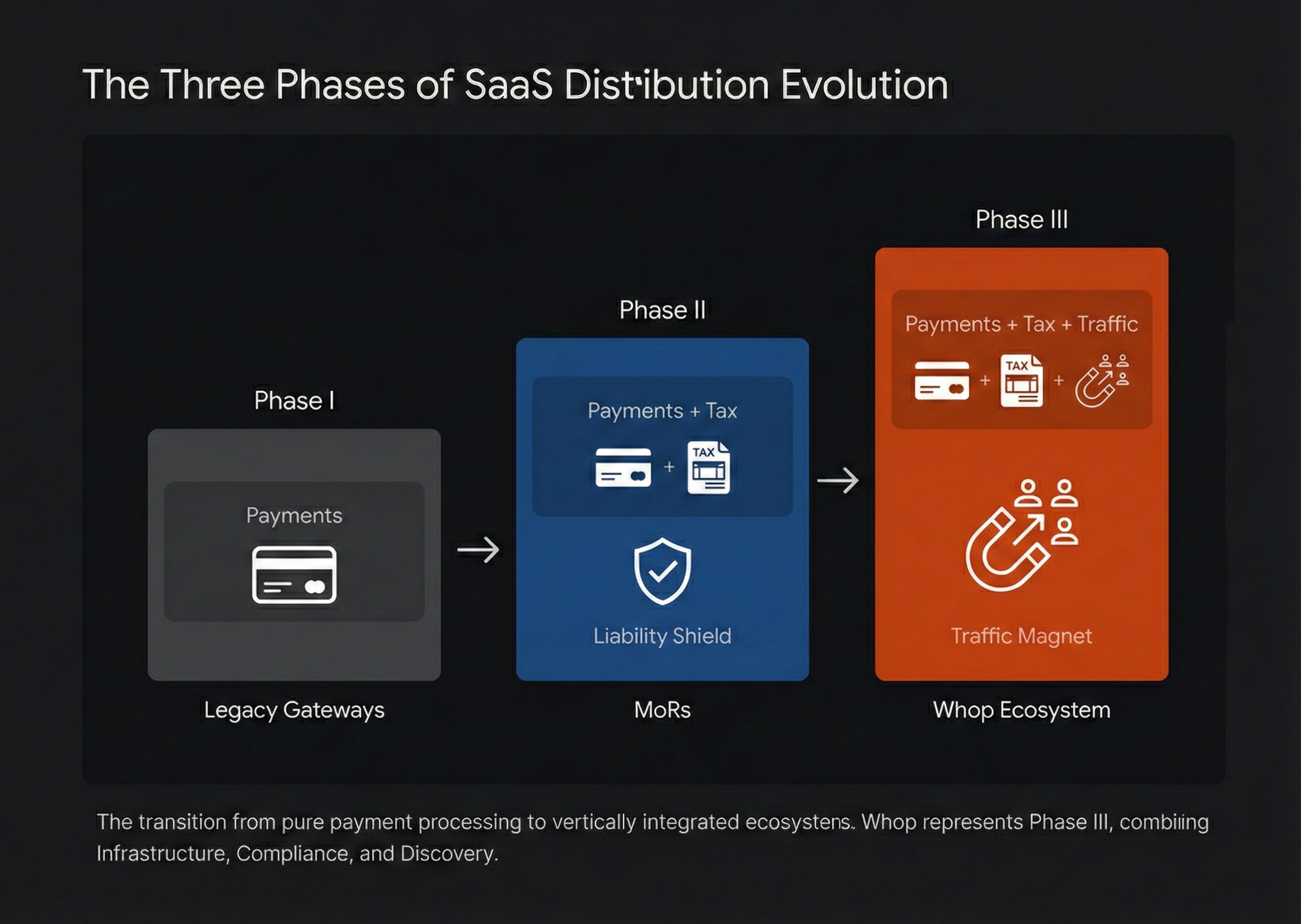
The choice of MoR is the single biggest determinant of your "Administrative Leverage." We compared the three dominant models: The Legacy Marketplace (Gumroad), The Modern Infrastructure (Lemon Squeezy), and The Ecosystem App Store (Whop).
1.1 The Fee Structure: Where Do Your Margins Go?
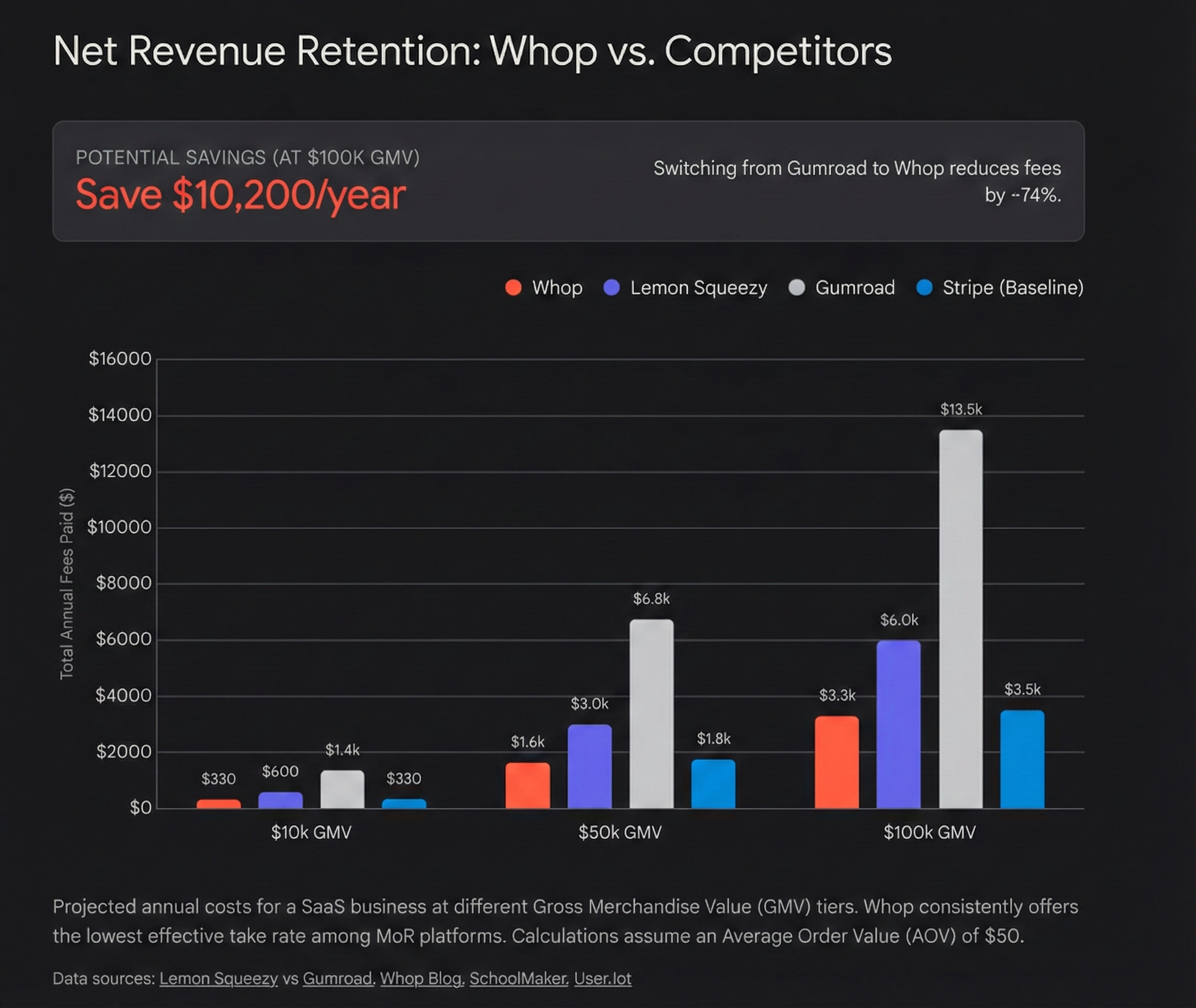
For a SaaS business generating $100,000 in Gross Merchandise Value (GMV), the difference in platform fees is stark.
Gumroad (The "Success Tax")
Charges a flat 10% + processing fees.1 If a sale comes from their "Discover" marketplace, the fee jumps to 30%.2 As you scale, this becomes punitive. At $100k revenue, you pay ~$13,000 in fees.3
Lemon Squeezy (The "Infrastructure" Premium)
Charges 5% + $0.50 per transaction.3 While better than Gumroad for volume, it provides zero traffic. You are paying strictly for the tooling, not the customer acquisition.4
Whop (The Efficiency King)
Charges 3% for sales involving automations (like Discord/SaaS integration).5 For standard transactions, the fee is 2.7% + $0.30.2 Crucially, Whop provides the same tax compliance and liability shielding as the others but at nearly half the cost of Lemon Squeezy.
Verdict
Whop is the mathematically superior choice for volume. A developer switching from Gumroad to Whop at $100k ARR saves approximately $10,200/year—capital that can be reinvested into ads or development.5
1.2 "Time to First Dollar" & Developer Experience
Lemon Squeezy
Excellent for "Purist SaaS." If you are building a custom web application and just need a billing API, Lemon Squeezy's developer experience is top-tier. However, you launch to an empty room; you must bring your own traffic.6
Whop
Superior for "bundled" value. Whop allows you to sell a software license key and access to a private Discord community in a single transaction.5 For "vibe-coders" selling scripts, bots, or tools, this bundling increases perceived value and conversion rates. The "Time to First Dollar" is faster on Whop because you can list on their marketplace immediately.7
// Part II: The Discovery Engine – Solving the "Empty Room" Problem
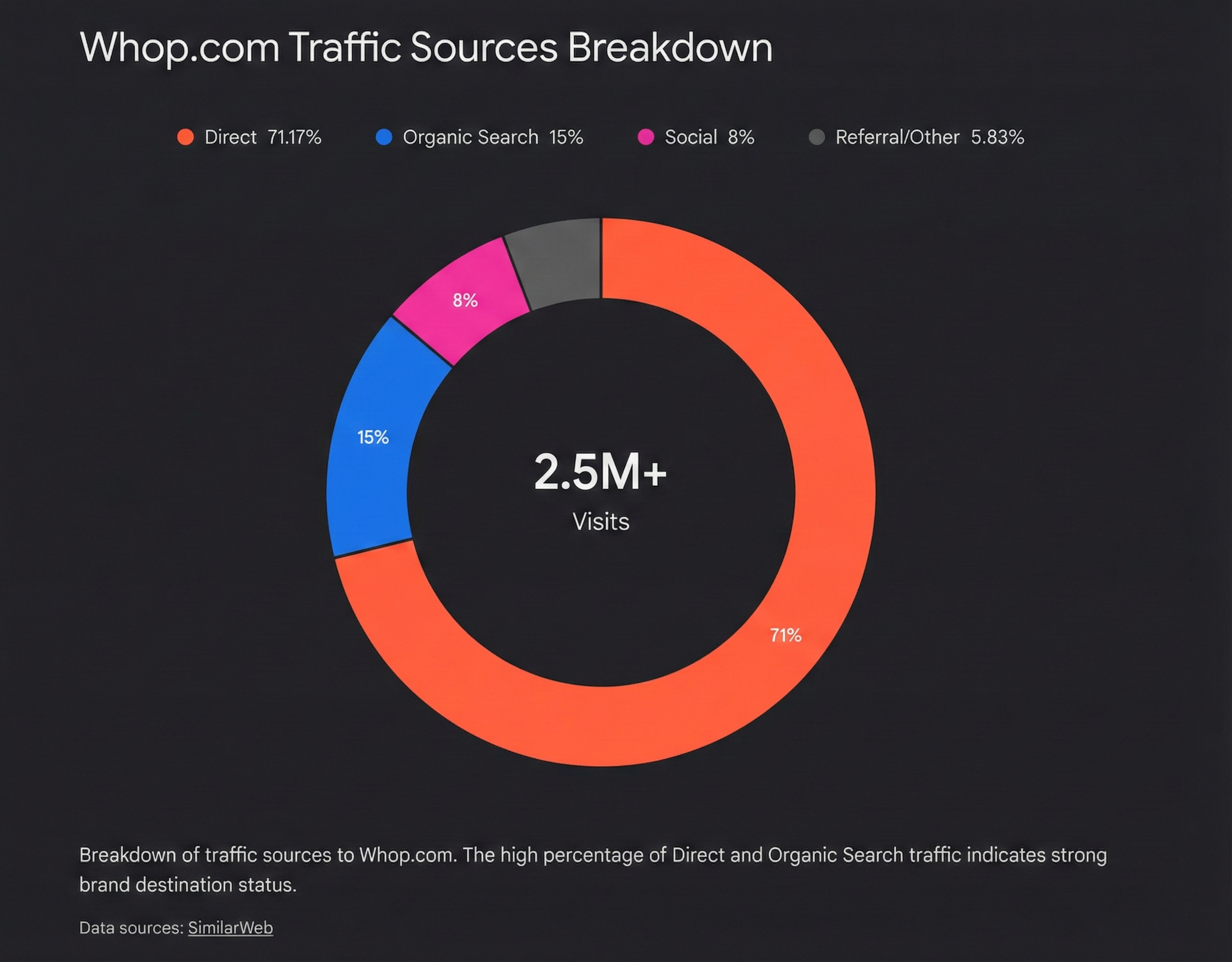
The most significant finding in our research is the power of the Whop Marketplace. Unlike Lemon Squeezy (which is invisible to consumers), Whop is a destination site with 15.37M monthly visits as of late 2025.8
2.1 Traffic Sources: The "App Store" Effect
Direct Traffic (71%): The vast majority of Whop's traffic is direct (71.17%), meaning users are coming to Whop specifically to search for tools and communities.9 This creates a "mall" effect where your product can be discovered simply by being on the shelf.
The "No-Cure, No-Pay" Model: Whop charges a 30% marketplace fee only on sales that originate from their organic discovery engine.2 If you bring the customer via your own link, you pay only the standard ~3%. This is effectively a risk-free marketing channel with a fixed Cost Per Acquisition (CPA).
2.2 Case Study: The "Land Survey Drafts" Anomaly
A niche CAD training business on Whop scaled to $40k–$60k/month by leveraging this ecosystem.10 The key lever was bundling software tools with community support. Users didn't just buy a tool; they bought a "career upgrade" package. This bundling is native to Whop but requires complex custom coding on Stripe/Lemon Squeezy.
// Part III: The Retention Layer – Community as a Moat
Retention is the new growth. For technical tools, "Community" is the highest-leverage retention mechanism.
3.1 The "Support Community" Model
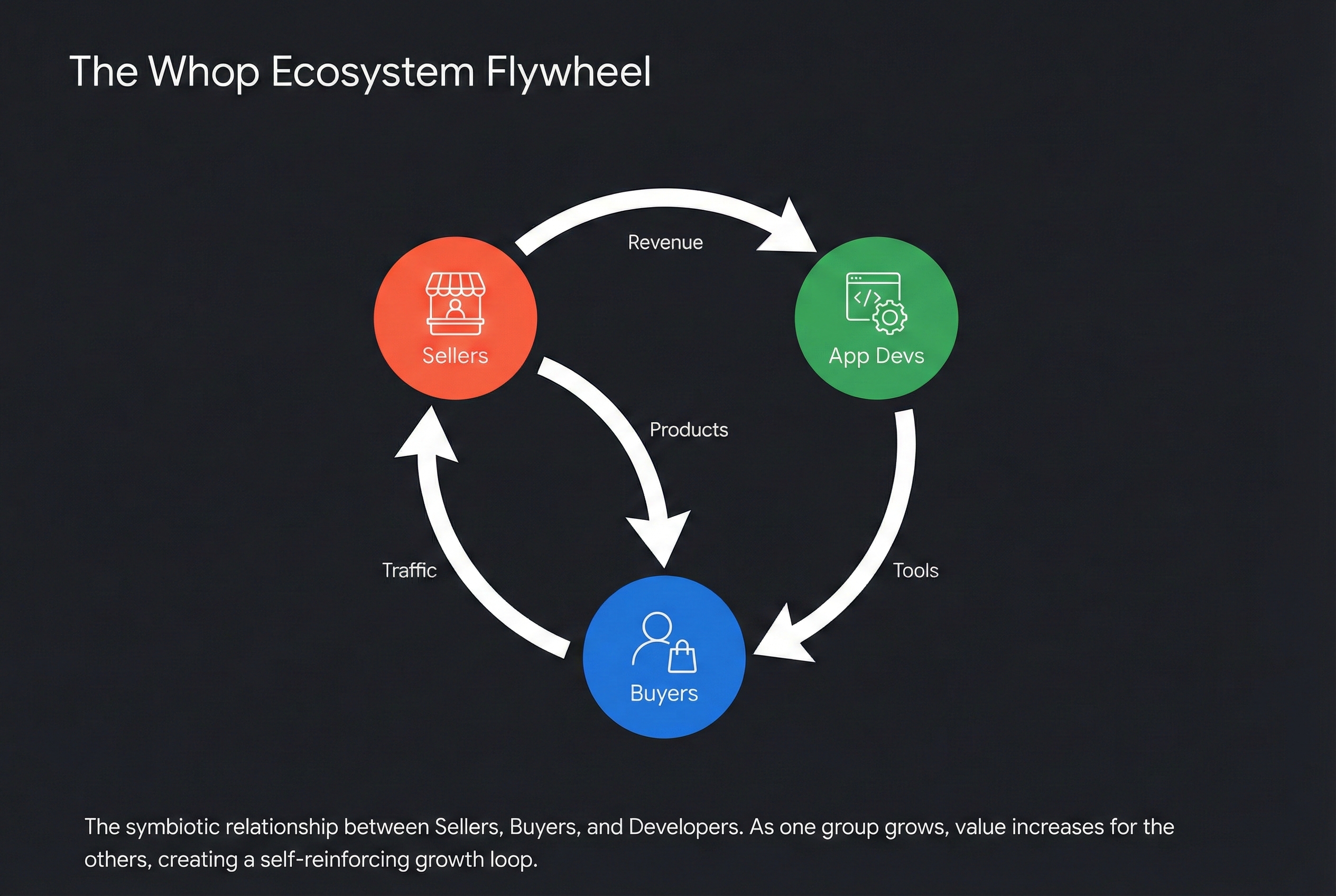
Whop's Native Integration: Whop creates a seamless link between payment and Discord/Telegram roles. If a payment fails, the user loses access to the community immediately.5 This social pressure reduces churn significantly compared to email-only dunning.
The Vibe-Coder Advantage: You don't need to build a customer support dashboard. Your Discord is the support dashboard. This offloads the "support burden" to the community itself, where power users often answer questions for new users.11
3.2 The Newsletter Layer: Beehiiv
While Whop handles the community, Beehiiv handles the nurture.
- Tech Newsletter Open Rates: In 2025, developer-focused newsletters are seeing open rates of 43.46%, far higher than the general marketing average.12
- The Strategy: Use Beehiiv to publish "Build Logs" (technical content). Use Beehiiv's Recommendation Network to grow passively; newsletters utilizing this feature grow 2.75x faster than those that do not.13 Drive this traffic to your Whop store for conversion.
// Part IV: The Acquisition Layer – Engineered Traffic
For the developer who wants to avoid "spammy" marketing, we identified two high-leverage channels: Whop Ads (Internal) and the "Reply Guy" Protocol (External).
4.1 Internal Leverage: Whop Ads & Content Rewards
Whop has launched an internal ad network that is currently underpriced.
- Whop Ads: You can bid on keywords to appear in the Whop marketplace. CPCs are efficient because you are targeting users who are already in a "buying" mindset.
- Content Rewards: This is a novel feature where you pay creators per 1,000 views (e.g., $3.00/1k views). This allows you to pay for attention rather than just clicks, leveraging User Generated Content (UGC) at scale without managing individual influencers.
4.2 External Leverage: The "Reply Guy" ROI
For zero-budget marketing, the "Reply Guy" strategy on X (Twitter) remains the most efficient use of time.
- The Protocol: 30 minutes/day posting helpful, non-salesy replies to large accounts in your niche.
- The Data: A 2025 case study showed this method generated 550k impressions and $1,200 in immediate revenue with just 15 hours of total effort.14
- Automated Validation: This strategy validates your messaging before you spend money on ads. If a reply gets likes, the angle works.
// Part V: The Unified 2026 "Distribution Stack"
Based on the combined data, here is the recommended stack for the Vibe-Coder.
The Stack Architecture
| Component | Platform | Why? (The Data Backing) |
|---|---|---|
| Merchant of Record | Whop | 3% fee (vs 5-10% on others).5 Handles global tax. $10k/yr savings at scale.3 |
| Storefront | Whop | 15.37M monthly visits.8 Built-in SEO ranking for niche tools.15 |
| Community | Discord (via Whop) | Automated role management reduces churn.5 Community support lowers support costs. |
| Newsletter | Beehiiv | 43.46% open rates for dev content.12 Recommendation network drives free subs.13 |
| Paid Ads | Whop Ads / Content Rewards | Pay-per-view model ($3/1k views) is cheaper than LinkedIn's $9.50 CPC.16 |
| Free Traffic | X "Reply Guy" | Validates messaging. $80/hr effective return on time spent.14 |
The Playbook: How to Execute
- Build & Bundle: Wrap your SaaS tool/script in a Whop "Pass." Bundle it with a Discord role ("Premium Support").
- The Cold Start: Spend $300 on Whop Content Rewards paying $3-$5 per 1,000 views. This generates authentic UGC and initial traffic.
- The Organic Engine: Commit 30 mins/day to X/Reddit. Search for problems your tool solves. Reply with the solution, not the link. Put the link in your bio (which links to your Whop store).
- The Nurture: Capture emails on Whop and sync them to Beehiiv. Send a weekly "Build Log" on Fridays.
- Scale: Once you hit $5k MRR, use the savings from Whop's lower fees to fund Reddit Ads (targeting specific subreddits) to diversify traffic sources.16
This stack minimizes "marketing fluff" and treats distribution as an engineering problem: optimizing for the lowest fees, highest intent traffic, and automated retention.
Works Cited
- Gumroad Fees: What to Watch Out for & Alternative | 2025 - Wise, accessed January 12, 2026, https://wise.com/us/blog/gumroad-fees
- Whop Review 2026: Features, Pricing & Alternative. | Dodo Payments, accessed January 19, 2026, https://dodopayments.com/blogs/whop-review
- Payment Processor Fees Compared: Stripe, Polar, Lemon Squeezy, Gumroad - UserJot, accessed January 19, 2026, https://userjot.com/blog/stripe-polar-lemon-squeezy-gumroad-transaction-fees
- Gumroad Alternative • Lemon Squeezy vs Gumroad, accessed January 19, 2026, https://www.lemonsqueezy.com/gumroad-alternative
- Whop Pricing 2026: Plan Comparison, Transaction Fees & Alternatives - SchoolMaker, accessed January 19, 2026, https://www.schoolmaker.com/blog/whop-pricing
- How I Simplified My SaaS Payments (and Why I Switched to Lemon Squeezy) - Reddit, accessed January 19, 2026, https://www.reddit.com/r/SaaS/comments/1op85aw/how_i_simplified_my_saas_payments_and_why_i/
- From Memberful to Whop: MySportsPick's monthly recurring revenue (MRR) skyrockets by 20x, accessed January 12, 2026, https://whop.com/blog/mysportspick/
- whop.com Website Traffic, Ranking, Analytics [December 2025] - Semrush, accessed January 19, 2026, https://www.semrush.com/website/whop.com/overview/
- whop.com Traffic Analytics, Ranking & Audience [December 2025] - Similarweb, accessed January 19, 2026, https://www.similarweb.com/website/whop.com/
- He makes $40k a month teaching a skill you've never heard of - Whop, accessed January 12, 2026, https://whop.com/blog/jasen-hunt-land-survey-drafts/
- I run an online community with over 6,000 members: here's what I've learned - Whop, accessed January 19, 2026, https://whop.com/blog/online-community-advice/
- Email Marketing Benchmarks 2025: Is Your Open Rate on Track - MailerLite, accessed January 12, 2026, https://www.mailerlite.com/blog/compare-your-email-performance-metrics-industry-benchmarks
- The State of Newsletters 2026 | beehiiv Blog, accessed January 12, 2026, https://www.beehiiv.com/blog/beehiiv-the-state-of-newsletters-2026
- I got 500K+ impressions on Twitter/X in 4weeks with this strategy, accessed January 12, 2026, https://medium.com/the-efficient-entrepreneur/how-to-grow-on-x-twitter-in-14-days-f7802e1a21b8
- Optimize your Whop's SEO!, accessed January 19, 2026, https://whop.com/discover/optimizeyourwhopseo/
- Reddit Advertising vs LinkedIn Ads for B2B: Cost, Quality, and ROI Compared - Odd Angles Media, accessed January 12, 2026, https://odd-angles-media.com/blog/reddit-advertising-vs-linkedin-ads-for-b2b-cost-quality-and-roi-compared
Ready to Execute?
You've seen the research. You understand the systems. Now it's time to implement the exact protocol that turns this data into revenue.
Launch The Protocol →